How to Get Into Modelling With No Experience
Blog · Booked
How to Get Into Modelling With No Experience
The Diversity Agency is a London model agency founded in 2016. We represent around 330 models across every board, and a large share of them arrived with no experience at all: no portfolio, no training, no industry contact. This guide explains how to get into modelling with no experience in the UK, what agencies actually want from a raw applicant, and why paying for photos before you apply is backwards.
Do you need experience to become a model?
No. You do not need experience, a portfolio, modelling classes or a paid photoshoot to get signed by a UK model agency. Agencies sign people based on how they look, how they carry themselves and how reliable they seem, not on what they have already done. A complete beginner with good phone photos and a professional attitude is signable on day one.
This surprises people, because the industry looks closed from the outside. It is not. Agencies exist to develop new faces. If everyone arrived fully formed, there would be nothing for a booker to do. When we open an application at TDA, we are not scanning a CV. We are looking at a set of plain phone pictures and asking one question: could a client book this person?
Experience can even work against you if it is the wrong kind. A folder of heavily edited "portfolio" images from a pay-to-shoot studio tells a booker less than four honest phone photos taken by a friend in daylight. If you have zero experience, you have zero bad habits to unlearn. Start from there.
If you want the broader step-by-step route into the industry, read our full guide on becoming a model in the UK. This post stays on the no-experience question specifically.
What do agencies look for instead of experience?
Agencies look for a bookable face, honest recent photos, accurate measurements and signs that you will turn up on time and behave professionally. That is the whole list. Everything a client pays for on a shoot day, from posing to working with a photographer, can be taught or picked up on the job.
Break that down from the booker's side of the desk:
- A look a client can use. Commercial and e-commerce clients want casts that look like the UK: every ethnicity, size, age, height and gender. You do not need to look like a magazine cover. You need to look like someone a brand's customer recognises.
- Honest digitals. Plain, unedited photos that show exactly what you look like today. More on how to take these below.
- Accurate stats. Height, dress or suit size, shoe size, and measurements taken properly, not guessed. A client books against these numbers. If a jacket does not fit on set because the stats were wrong, that is a problem for everyone.
- Reliability signals. Replying to emails promptly, filling in forms correctly, being straightforward about availability. Bookers notice this from the very first message. A model who is easy to deal with gets put forward more often, and that starts before you are even signed.
Notice what is not on the list: a portfolio, a modelling course, catwalk training, previous jobs. We have written a full breakdown of what agencies want if you want the detail behind each point.
Why is paying for a portfolio first backwards?
Paying for a portfolio before you have an agency is backwards because agencies do not sign people from portfolios, and any decent agency will build your book properly after you sign, at no upfront cost to you. Spending hundreds of pounds on studio photos before applying solves a problem that does not exist.
Here is the logic from our side. A paid portfolio shot before signing is built to flatter: retouched skin, styled hair, dramatic lighting. That is exactly what a booker cannot use, because we need to know what you look like when you walk into a casting on a Tuesday morning. We will ask you for plain phone digitals anyway, whatever glossy folder you attach.
The businesses that tell you otherwise are usually selling photography, not representation. "You need a professional portfolio before any agency will look at you" is a sales line, and it has taken money off a lot of hopeful applicants. Representation at a legitimate UK agency is free and commission-based. The agency earns when you earn, from a percentage of the jobs it books you. If money is flowing the other way before you have worked a single day, something is wrong.
Once you are signed, your book gets built the right way round: test shoots arranged through the agency, images chosen by people who know what clients in your category respond to, and a portfolio that grows with real jobs. That order matters. Sign first, shoot after.
How do you take digitals at home on a phone?
Digitals are plain, unedited photos taken on a phone in natural daylight, wearing simple fitted clothing, with no makeup and no filters. Every UK agency asks for roughly the same set, and they are the only "photos" you need to apply with no experience.
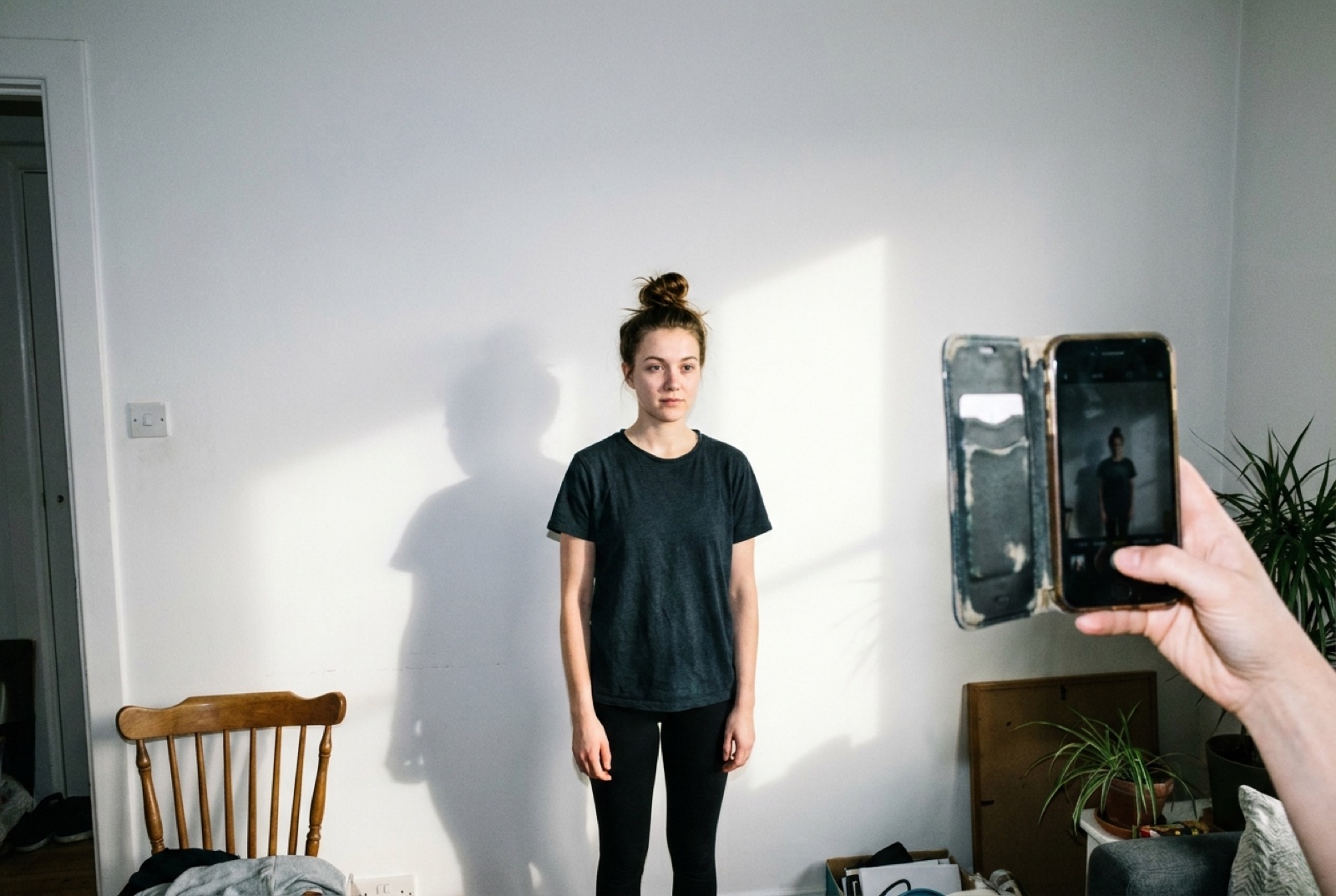
Here is the standard set and how to shoot it:
- Head-on headshot: shoulders up, facing the camera, neutral expression, hair off the face.
- Smiling headshot: same framing, natural smile. Commercial clients book smiles, so do not skip it.
- Profile: head and shoulders from the side.
- Full length, front: standing straight, arms relaxed, feet visible.
- Full length, side and back: same distance, same light.
And the conditions:
- Light: stand facing a window in daytime. Indirect daylight is the most honest light there is. No overhead bulbs, no ring lights, no golden-hour glow.
- Background: a plain wall. Clear the laundry out of the frame.
- Clothing: fitted and simple. Plain vest or t-shirt and fitted jeans or leggings work for almost everyone. Modest applicants can shoot in fitted modest wear; we sign for a modest board and know exactly how to read those digitals.
- Face: no makeup, or the bare minimum. No filters, no editing, no beauty mode. Turn beauty mode off in your camera settings; many phones have it on by default.
- Camera: have someone else hold the phone at your chest height, a few steps back. Not a selfie, not a mirror shot if you can avoid it.
The whole set takes fifteen minutes and costs nothing. If a booker wants to see anything more, they will ask. Honest and recent beats polished and old every single time.
How do you apply to a model agency with no experience?
You apply directly through the agency's own website form, with your digitals, your accurate stats and your contact details, and you apply to several agencies whose boards actually match you. That is the entire process. No agent-of-an-agent, no paid registration, no "casting event" tickets.
A sensible order of work:
- Shortlist agencies that fit you. Look at each agency's boards. If you are curve, over 50, petite, modest, or a person of colour looking for an agency where that is the core of the roster rather than a token corner, apply to agencies that visibly book that work. Applying to a high-fashion editorial house at 5'4" wastes your time and theirs.
- Use the official application form. Every legitimate UK agency has one on its website. Ours is at apply to TDA and it is free, like every legitimate agency application.
- Fill in every field accurately. Measure your height against a wall without shoes. Check your current dress or suit size. Guessing generously helps nobody; the tape measure wins on set.
- Attach your digitals. The set described above. Nothing else needed.
- Apply to a handful, not one. Agencies have different gaps on their boards at different times. A no is often about roster balance, not about you.
One thing worth saying plainly: do not pay anyone to submit you. Third-party "platforms" that charge a monthly fee to put your profile "in front of agencies" are a toll booth on a road that is free.
What happens after you apply?
After you apply, the agency reviews your submission, and if there is potential you will be invited to a short interview or an in-person meeting; if you are not right for the roster, you will usually hear nothing or receive a brief no. Neither outcome requires you to do anything except wait a reasonable amount of time.
At TDA the sequence for a promising applicant looks like this:
- Review. A booker looks at your digitals and stats against what the boards need.
- Interview. A video call or in-person meeting. This is a conversation, not an audition. We are checking that you are who the photos say you are, that your expectations are realistic, and that you can hold a professional conversation. You are also checking us, and you should.
- Decision and contract. If it is a yes, you get a written agreement to read. Take your time with it. A legitimate contract sets out commission on work booked; it does not invoice you for joining.
- Onboarding. Your profile goes up on the agency site, your details go into the systems clients search, and the agency arranges proper digitals or a first test shoot to start your book.
If you hear nothing after a few weeks, one polite follow-up is fine. Radio silence after that means move on to the next agency on your shortlist and reapply in six to twelve months if your look or stats change. Rosters shift constantly. A no in March can be a yes in November.
How do you spot scams that target inexperienced applicants?
The single rule that filters out almost every modelling scam is this: never pay upfront. Legitimate agencies earn commission on the work they book you, so any "agency" asking for registration fees, portfolio fees, admin fees or compulsory paid photoshoots is running a photography sales operation, not a model agency.
Scams aim at people with no experience precisely because you have no reference point for what normal looks like. Normal looks like this: you pay nothing to apply, nothing to interview, nothing to sign, and the agency takes a percentage of jobs after you have been paid for them.
Red flags, from most common to most brazen:
- "You need a professional portfolio first, and we have a studio." The classic. The agency and the photography studio are the same business, and the portfolio is the product.
- Registration or admin fees to "activate your profile" or "put you on the books".
- Street scouting that leads to a sales meeting. Real scouts exist, but a scout whose follow-up is a card-machine appointment is a salesperson.
- Guaranteed work. No honest agency guarantees bookings. Clients choose models; agencies put you in front of them.
- Pressure and deadlines. "This rate is only available today" is retail tactics, not casting.
- Vague companies. No named bookers, no visible roster, no checkable clients, a website that is all stock photography.
We keep a longer field guide on spotting modelling scams, including what to do if you have already paid. The short version stands on its own: money flows from client to agency to model. Any other direction, walk away.
How much can a first-year model realistically earn?
A first-year model in the UK should treat modelling as irregular paid work alongside a job or studies, not a salary; a typical commercial day rate sits in the hundreds of pounds, but new faces may book only a handful of days in their first year, and some book none. Anyone promising you specific figures before you have worked is guessing at best.
The honest shape of year one:
- Months one to three: onboarding, digitals, first tests, first submissions to castings. Often no paid work yet. This is normal and not a sign anything is wrong.
- Months three to nine: castings start converting for some new faces. E-commerce, commercial stills and lifestyle shoots are the usual first jobs, because those clients book the widest range of real-looking people.
- Months nine to twelve: if clients rebook you, the pattern becomes visible. Repeat bookings, not one big job, are what a career is built on.
Rates vary enormously by usage: a day shooting e-commerce pays differently from a national advertising campaign, because the client is buying the right to use your image, and wider use costs more. We have laid out real ranges in our guide to UK model earnings.
Keep your job. Keep your course. The models who last are the ones whose rent never depends on next month's castings, because that freedom lets them say no to bad work and yes to the right work.
What are the biggest myths about age, height and size?
The biggest myth is that modelling requires you to be young, tall and thin; that describes one narrow lane of high fashion, while the bulk of paid UK modelling work, in commercial, e-commerce, beauty and TV, books every age, height and size because brands need casts that look like their customers.
Taking the myths one at a time:
- "You have to be 5'9"." Height requirements belong to runway and some editorial fashion. Commercial and e-commerce clients book petite models, average-height models and everyone in between. We run boards where height is simply a stat, not a gate.
- "You have to be a size 6." Curve and plus-size is one of the busiest areas of commercial modelling, and the demand is client-driven, not charitable. Brands sell clothes in a full size run and need to show them on bodies that match.
- "You have to be young." Mature and over-50 models are consistently booked for finance, healthcare, travel, retail and lifestyle campaigns. If anything, older new faces are scarcer, which works in your favour.
- "You have to look a certain way." The founding premise of this agency, back in 2016, was that the industry overlooked enormous amounts of bookable talent: Black, South Asian, East Asian, MENA, mixed-heritage, modest and hijabi, non-binary, tall, petite, curve. That work exists and grows every year. Diverse casting is not a favour to anyone; it performs, and clients know it.
- "It's too late to start." With no experience, at 19 or at 55, the entry route is identical: digitals, application, interview. Nobody is checking how long you have wanted this.
The only real gate is honest self-assessment about category. A 5'3" applicant is not a runway prospect, and an agency that says so is being useful, not cruel. The same applicant may be exactly right for petite, commercial or beauty work. Apply to the lane that fits.
Frequently asked questions
Can I become a model with no photos at all?
Yes, in the sense that you do not need any existing photos: you create the only photos required, a set of phone digitals, in about fifteen minutes at home for free. No agency worth applying to expects anything more from a first application.
Do I need a modelling course or classes before applying?
No. UK agencies do not ask for training, and paid "modelling academies" are not a route into representation. Posing, walking and set etiquette are learned through agency test shoots and real jobs after signing. If a company links its course to promises of agency introductions, treat it as a red flag.
How old do you have to be to start modelling with no experience?
There is no upper age limit, and minors can model with parental consent and, for under-16s working on productions, local authority child performance licensing. Agencies sign new faces from childhood through to their seventies and beyond. For adults, "too old to start" is a myth the commercial sector disproves daily.
How long does it take to get signed with no experience?
Anywhere from days to months. If your look fills a gap on an agency's board, an application can turn into an interview within a week. If boards are full in your category, you may wait or need to reapply later. Application review times of two to six weeks are common, and silence usually means no for now, not never.
Should I pay a photographer before applying to agencies?
No. Agencies assess applications from phone digitals, and a legitimate agency arranges proper shoots after signing without charging you upfront. Money spent on pre-application portfolios is money the industry did not ask for. If you love photography and want a creative shoot for yourself, enjoy it, but know it will not move your application.
Can I apply to more than one agency at the same time?
Yes, and you should. Applying to several suitable agencies at once is standard practice and no agency is offended by it. Exclusivity only becomes a question once you are offered a contract, at which point you read the terms and choose. Until then, cast a sensible net across agencies whose boards fit you.
What should I wear for digitals if I dress modestly?
Fitted modest clothing works: the aim is to show your proportions honestly, which fitted long sleeves, a fitted maxi or fitted trousers do perfectly well. Hijabi applicants should shoot in a plain, neatly worn hijab in a solid colour. Agencies with modest boards read these digitals every week and need no special explanation.
Are modelling jobs with no experience actually paid?
Yes. Once you are signed and booked, you are paid the same rates as any other model on the job; clients pay for the shoot day and usage, not for your CV. Unpaid work exists in the form of test shoots, which build your book and are a normal part of development, but a paid booking is a paid booking from day one.
Start with fifteen minutes and a phone
Getting into modelling with no experience comes down to a short, free sequence: take honest digitals in daylight, measure yourself properly, and apply to agencies whose boards match who you are. No portfolio, no course, no fee, and no permission needed from anyone.
If that is you, we would genuinely like to see your application. TDA has been signing overlooked, first-time faces since 2016, across every ethnicity, size, age, height, gender and faith. Send your digitals through our application form and a booker will look at them. If you are a brand or casting director reading this instead, our roster is a message away via the contact page.
The industry is not as closed as it looks from outside. The door is a web form. Use it.